
 I am a forever student of life. I love learning and discovering how I (and the rest of the fantastical elements) work in this amazingly magical world we get to live in, and I say that as a very logical, practical pupil who likes tangible results and measurable outcomes not one of a blind-faith trust-falling person. I would even go so far as to admit that I have very little trust and no faith, having been raised in an atheistic home with things being very black and white and there being only what we can see or the scientific method to prove our reality. That said, I can’t help being awed by the amazing life we all find ourselves a part of: energy, motion, sound, adventure.
It really is an amazing experience that we get to participate in. And that, in and of itself, can be not only overwhelming, but often unmanageable. I often think about people hundreds of years ago, pre-technology just scraping by through the demands of their lives, what they must have still been overwhelmed by and reverent of; just looking at the various gods and monsters created gives us a small glimpse into their passions. Now flashing back to us and our ever present leashes, our computers and cell phones, with email, twitter, the book of faces and any other imaginable app to distract and “assist” us on our crazy responsibility-laden paths. It can really get suffocating.
So how do we learn to work with ourselves and cope in a very concrete way, so that we can present our best versions into the world, while still getting to milk the richest cream from our experiences? It all originates with our minds and our perceptions of things. Side note, I am a certified hypnotherapist in addition to my various other pursuits – I told you I am a perpetual pupil and love soaking up as much as I can! — and when I was in school getting my degree, we did extensive work on the conscious mind versus the subconscious and how our physiognomy (bodies and physicality) is directly influenced by the perceptions we have/the ideas (the numerous subconscious relationships we have) about whatever information we receive. By changing this subconscious relationship we have the power to change the physical/mental reaction we are experiencing. It is as easy as that. Ha! But how easy can that be really?
For example, let’s say that when you have to go to a job interview you get sweaty palms, your heart beats faster and you can’t seem to think clearly. It is in part due to the amygdala fight/flight response switching on in your brain based on your reaction to the situation: “Oh no, I’m in a new situation, the unknown is scary (this is fact for all humans, “brave” folks only muster the courage to take action anyway), the last interview went terribly, interviews are awful…” and on and on. Now, if you were a completely logical person—oh, where is your Spock side when you need him? –you might say to yourself, “It is silly to be afraid. Either they will hire me based on my credentials– and let’s face it they would be crazy not to with how skilled I am –or they won’t think I am the best fit and I will simply find a different position better suited to my abilities.” But we are hardly that detached from our experience. We feel the need to please, or the pressure of needing a good-paying job, or many other responses.
So what can we do to change this subconscious relationship (when we aren’t even aware we are feeling that way and it is guiding our responses)? Much like a little kid sitting in a car-seat with a toy steering wheel might think they are driving the car (they see things moving out the window and feel the pressure of physics acting on their tiny body), all the while the person in the driver’s seat is actually setting the course, steering and braking. That is the battle of your conscious (kid with the wheel) versus your subconscious (person in driver’s seat). No matter what that kid does with the wheel, they can’t stop the car or turn it to avoid obstacles. In order to make those changes, they need to be aware of the reasons they are taking certain actions that may ultimately be self-destructive, thereby putting themselves in the driver’s seat of the car of their life. We need to access the subconscious mind that has filed every experience we have ever had into good or bad categories, and naturally categorizes things we don’t know yet into bad (‘cause once again the unknown is SCARY!). So how do we get to this closed vault hidden inside that our thinking brain isn’t even aware is the one really driving?
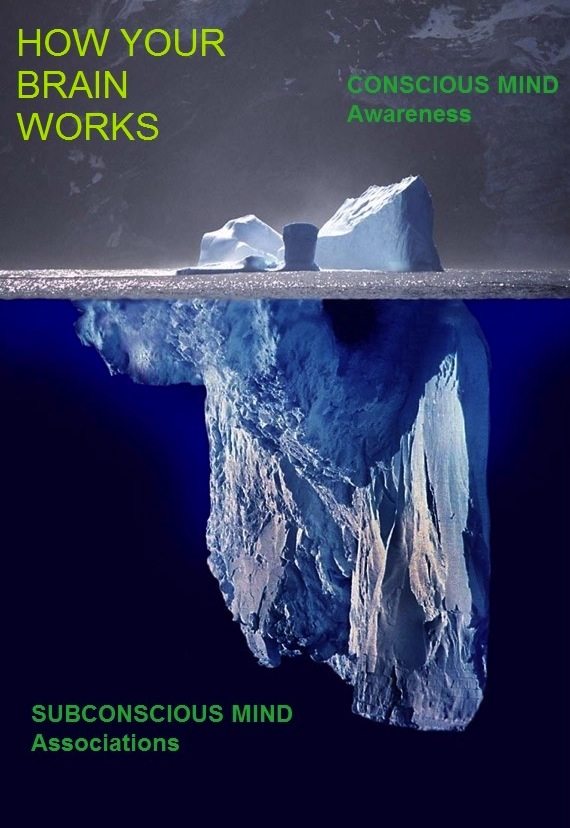 If we look at the mind like the tip of the iceberg floating in the water with almost ninety percent of its bulk under water, the conscious is the part we can see: that pretty white and blue icy island happily ignoring its larger heftier better half below the water, and that disproportionate powerhouse, silent and still under the turbulent waters, is the subconscious: our storeroom of experience. In order to access this awareness and start changing the associations we have in that part of our library of life we have to go into hypnosis. [Before I continue, let me briefly address two myths: 1) everyone can be hypnotized – you can’t learn new things, fall asleep or be human without being able to go into this state, and 2) it is perfectly safe – no one can force you to do or say anything you don’t want to.]
Honestly, there is no need to change everything. You fear sticking your hand into fire because there is an association in place: to keep you safe. But for your irrational fears, compulsions or things that aren’t helping you achieve your goals, getting in your way, or limiting your higher state of self, you have the power to change your subconscious connections with them and ultimately your reactions to them. Changing those relationships can give you the power to change your behavior.
You can either work with a practitioner if there is an issue you want to specifically address like fear, smoking cessation, or weight loss (I used to have an irrational debilitating fear of flying, and used hypnosis to eliminate those reactions and now I fly with peace and calm, which is lucky as I do a lot of traveling for work!) or you can simply do self-hypnosis, a deeper form of meditation, where you put yourself into a relaxed state and start to repetitively tell yourself the new thing you want: better sleep, more relaxation, improved self-esteem, etc. There are numerous online guided-meditations and self-hypnosis scripts available with a quick search, as are practitioners who are available in almost every corner of the globe. So take the time to make the changes that will allow you to have the most positive experience of life that you can.
In a very tangible, evidence-based way, we all have the power to change our mind at a deeper level. There are a number of scientific papers with direct proof and efficacy analytics on the changes in biochemistry through this practice. The mind can be wondrous, but learning to work with your mind and not feel boxed in by ideas and thoughts that influence your actions and may not be serving you any longer can be even more enchanting! And the fact that your brain comes with its own toolbox to make these changes very material is amazing. So go ahead, feel free to use the tools you already to evolve into your best you.
To learn more about science of brain work:
http://www.ncbi.nlm.nih.gov/pmc/articles/PMC2802367/
http://hypnosishealthinfo.com/articles/biochemistry/
*Image creative commons license: Created by Uwe Kils (iceberg) and User:Wiska Bodo (sky), Tara Platt (text)